Nikolaos Oikonomopoulos’ research grant at Sophion’s Copenhagen labs marks an important step in advancing primary neuron APC assays for drug discovery.
As a MSc student at Ulm University and connected to Dr. Nadia von Schoubye’s lab at Boehringer Ingelheim in Biberach, Germany, Nikolaos Oikonomopoulos explores how acutely isolated neurons can be adapted for automated patch-clamp workflows. He reflects on challenges and opportunities in bringing more physiologically relevant neuronal models into APC-based drug discovery.
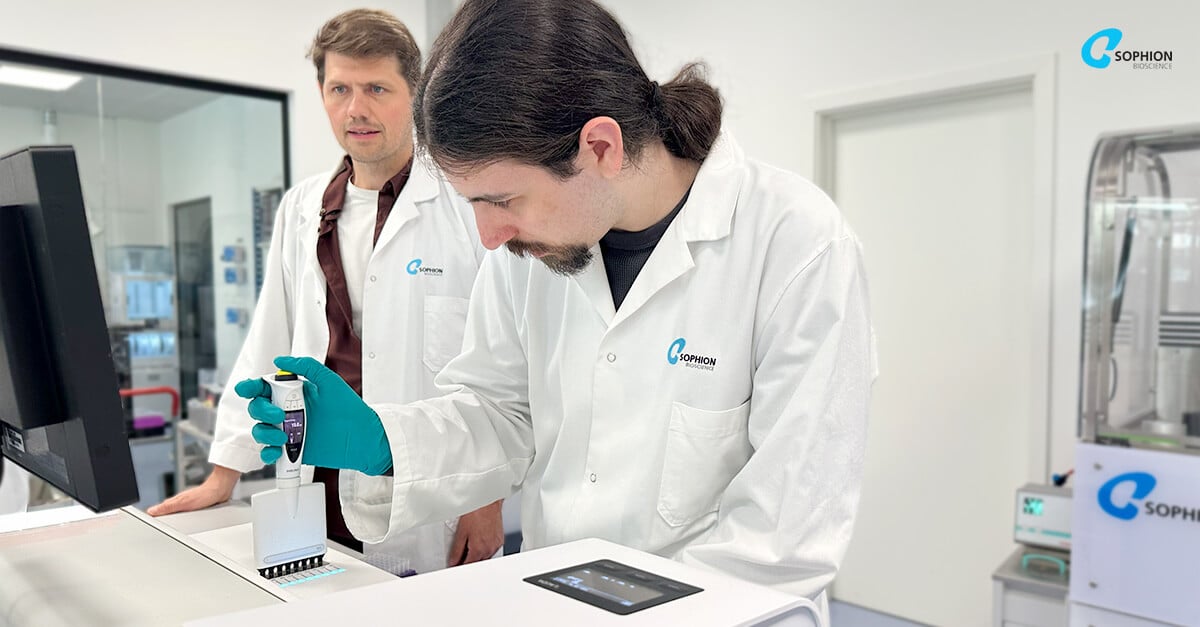
Research grant bridges neuroscience and APC in drug discovery.
Q: In a sentence or two, can you explain what you’re studying and why?
I study Molecular and Translational Neuroscience at Ulm University in Germany. Since childhood, I have been interested in how the mind works, but what drew me to this specific program was its focus on neurological diseases and disorders. Perhaps it’s a somewhat unconventional approach. But I believe that a good way of understanding how something functions in depth is to look at the details of how and why it can fail.
Q: In your ‘home’ lab, you routinely do traditional manual patch-clamp and slice recordings. How do you think you’ll adapt to learning APC techniques in our labs in Copenhagen?
Manual patch-clamp (MPC) felt intuitive to me from the very first attempt – I would go as far as to say I fell in love with the method. I’ve explored automated patch-clamp (APC) techniques, specifically the QPatch, in my home lab to prepare for my visit to Copenhagen and in some ways, they are just as intuitive to use. What I’ll need to adapt to is the difference in the kind of feedback I get, both real-time and in post-run analysis. With MPC, I rely on visual cues like pipette position and amplifier readings, as well as tactile feedback such as pressure control, which has become instinctive over time.
This same level of understanding and similar control is possible with APC as well; I am sure of that. It’s just a matter of adapting my mental map to fully take advantage of a different kind of feedback and control system. But it will definitely take some time and guidance until I can get to that point. I’m looking forward to both the challenge and the rewards of overcoming it.
Q: Acutely, isolated neuron recordings are challenging, whether via MPC or APC. What key challenges do you think you’ll face, and how will you aim to address them?
There is always a learning curve when patching a new cell type, and neurons are among the most fragile cells to work with. I won’t be surprised if my first handful of cells don’t make it to the end – or even the start, to be honest – of my protocol. Thankfully, the way to address that is simple; practice makes perfect. Also, some good advice from experienced colleagues will go a long way.
For APC specifically, assay optimization will likely be the most time-intensive challenge, both in terms of the recording protocol and cell handling. APC systems, such as the QPatch, require healthy, round cells. For neurons, that means getting rid of the neurites. There are a handful of ways to do this, some more ‘gentle’ than others. I’ll need to methodically determine which approach balances reliability with preservation of neurite-specific targets.
Addressing that balance is, in fact, the central focus of my project.
Q: Synaptic targets are central for insomnia, epilepsy, anxiety, and anesthesia. By targeting synaptic and dendritic ion channels, will there be an obvious disease that may be best suited to these studies?
This project serves as a broader proof of concept. The aim is to demonstrate that neurite retraction can be performed while preserving dendrite specific receptors, and that these modified primary neurons can be reliably used in APC to characterize compounds in a cell-type that is more neuronal-like than transfected immortalized cells. If successful, the protocol could be adapted by colleagues for a wide range of targets and further optimized depending on specific research needs.
The receptor here wasn’t chosen with any specific disease in mind, but rather for its dendritic expression pattern.
Other ways to approach these assays for R&D and drug screening are over-expressing stable cell lines or iPSC-derived neurons.
Q: Despite the challenges of acutely, isolated neurons, do you think they will be the best in vitro model?
Ideally, in vitro models should reflect what we see in vivo as closely as possible. But just by plating primary cells in a culture flask or a well-plate, expression patterns change. Though the divergence is not instant, it’s fast enough to matter.
Organoids may eventually bridge the gap between in vivo and conventional cultures, but at present, the technology is expensive, time-consuming, and not yet sufficiently mature for widespread use.
Q: Or is it likely that combinations of these different assays will give the most complete picture of the receptor activity and its modulation by test compounds?
Moving further from the physiological context, we have hiPSC-derived neurons, primary neurons from different mammals, transfected cells from immortalized lines, etc. It’s hard to make any overarching judgment on which is better. In some cases, targets are highly conserved across species; in others, a human model is essential but primary tissue is unavailable, making hiPSCs a necessary compromise. In contrast, transfected cell lines can be ideal when specificity and low background noise are the priority.
In short, it’s complicated. While there is a theoretical gold standard – human primary cells – in reality, we are constrained by time, costs and the unique requirements of our assays. What we use in the end depends greatly on what we need the cells for and what concessions we are able or willing to make. My hope for this project is that it helps establish another option for APC that fellow colleagues can choose when it best suits their experimental goals.
Q: What do you hope to achieve and take back to the lab?
My primary goal is to learn how the primary neuron QPatch assay is implemented and to establish a solid foundation for further optimization in my home lab. The expertise of the Sophion team in APC will allow me to hit the ground running and get a smooth start on the project.
Ready to move your research forward? Explore Sophion Research Grants and make an application for your own research with Sophion.